

 Login
Login
Central Government notifies Employees Deposit Linked Insurance(EDLI) Scheme, 2026
Notification attached
Central Government notifies Employees Deposit Linked Insurance(EDLI) Scheme, 2026
Notification attached
Central Government notifies Employees Pension Scheme, 2026
Notification attached
Central Government notifies Employees Provident Funds (EPF) Scheme, 2026
Notification attached
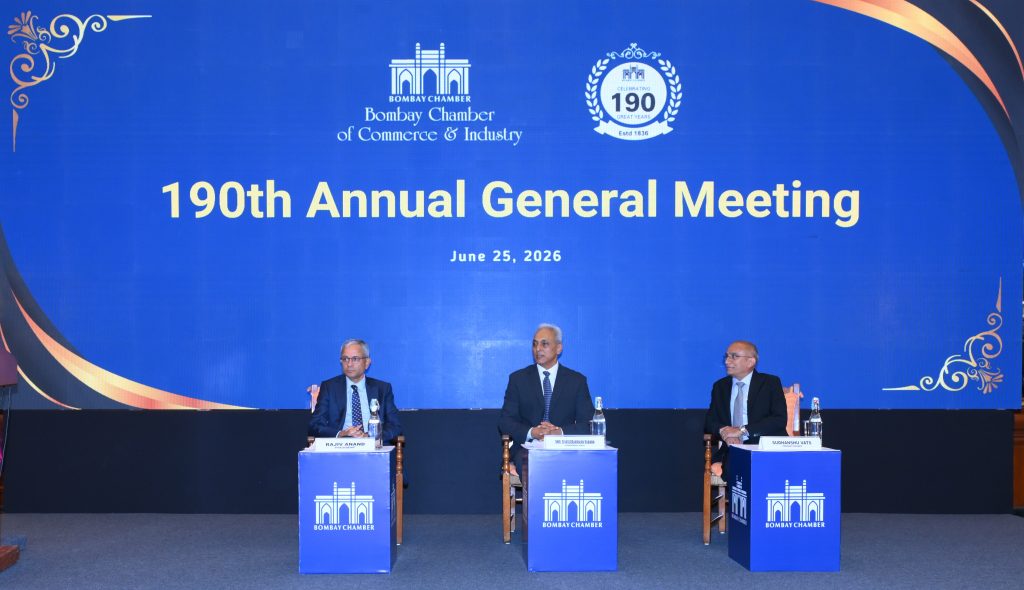
Mumbai, June 25, 2026: The Bombay Chamber of Commerce & Industry, India’s oldest chamber of commerce, ushered in a new chapter at its 190th Annual General Meeting, with Sudhanshu Vats, Managing Director, Pidilite, assuming office as President for 2026–27. Outlining a bold roadmap centred on artificial intelligence, MSME transformation, and Mumbai’s global competitiveness, Vats called for the Chamber to evolve into a “capability engine” that accelerates business growth while strengthening its role in shaping public policy.
Addressing members, Vats said, “As we celebrate the 190th year of the Bombay Chamber, one thing stands out clearly: our relevance has never come from standing still—but from evolving with purpose.”
Building on the Chamber’s existing theme of Innovation, Inclusion and Impact, Vats outlined three strategic priorities for the year ahead: placing Mumbai and Maharashtra at the centre of the Chamber’s agenda, empowering MSMEs through artificial intelligence, and transforming the Chamber itself through AI-enabled member services and policy engagement.
Highlighting Mumbai’s importance to India’s growth story, he said, “Our ambition is clear: to make Mumbai one of the world’s most competitive and future-ready economic centres of the 21st century.”
On MSMEs, Vats emphasised that while Maharashtra’s one crore MSMEs are the backbone of the state’s economy, they must now become technology-enabled enterprises. “Our vision is tobhelp MSMEs compete not as small players, but as intelligent, tech-enabled enterprises,” he said, announcing initiatives to simplify compliance, improve access to finance, and democratise
enterprise-grade capabilities using artificial intelligence.
He also announced that the Chamber itself would embrace AI by deploying intelligent digital agents to provide continuous member engagement, deliver data-driven policy insights and create an always-on advisory ecosystem. “As we call upon industry to transform, we must transform ourselves,” he remarked.

Paying tribute to outgoing President Rajiv Anand, Managing Director and CEO, IndusInd Bank, Vats acknowledged his leadership during a challenging global environment, stating, “Your clarity of purpose coupled with your humility and passion helped the Bombay Chamber continue to build on its momentum as we navigated the year successfully.”
In his farewell presidential address, Rajiv Anand reflected on a year defined by Innovation, Inclusion and Impact, built around five strategic pillars—sustainable economic growth, technology and innovation, human capital, public-private partnerships, and modernising the Chamber.
Over the past year, the Chamber organised more than 100 conferences, conclaves, seminars, workshops and training programmes, while strengthening its voice in policy advocacy, fostering industry-government collaboration, and expanding international partnerships.
Reflecting on his tenure, Anand said, “The Bombay Chamber is far more than India’s oldest chamber of commerce. It is a respected institution that has, for nearly two centuries, championed enterprise, shaped economic thought, and contributed meaningfully to the nation’s development.”
Expressing confidence in the Chambe’s future, he added, “Leadership is temporary, but the impact of collective purpose endures,” as he formally passed the baton to Vats.

The AGM’s Chief Guest, Shri Sivasubramanian Ramann, Chairperson, Pension Fund Regulatory and Development Authority (PFRDA), delivered the keynote address on the role of pension funds in building a developed India by 2047. He emphasised that economic progress must be measured not only by growth but by long-term resilience and social security.
“A nation does not become developed merely by growing large. It becomes developed when growth is matched by resilience,” Shri Ramann said.
Describing pension systems as both an instrument of human dignity and a source of long-term nation-building capital, he noted that pension funds can play a transformative role in financing infrastructure, technology, innovation and social development while providing financial security for India’s ageing population.

The evening concluded with a Vote of Thanks by Sandeep Khosla, Director General of the Bombay Chamber, who thanked the Chief Guest, Chamber leadership, past presidents, board members, committee leaders, members and stakeholders for their continued support. He also acknowledged the Chamber Secretariat for successfully organising the landmark Annual General Meeting and reaffirmed the Chamber’s commitment to building on its rich legacy while embracing innovation and future-ready growth.
NCW issues advisory for Mandatory POSH Audits and Robust Workplace Safety Mechanisms Nationwide
Police Complaint not mandatory to initiate domestic enquiry-Bom HC
Ref.: MCM/ADM/11
The Director General
Bombay Chamber of Commerce and Industry
Mackinnon Mackenzie Building
3rd floor, 4, Shoorji Vallabhdas Road
Ballard Estate, Mumbai – 400 001
Dear Sir/Madam,
Invitation for Bids
Please see enclosed notices for invitation for bids from organizations in Mauritius.
Prospective bidders may be requested to regularly visit the website to take cognizance of any addendum and/or clarification(s) issued.
The Consulate would highly appreciate if you could kindly circulate the Notices among the members of your Organization.
Thank you for your understanding and cooperation.
Yours sincerely,
Allegations of sexual harassment in transport not provided by employer cannot be investigated under POSH Act – Bombay High Court
Ref.: MCM/ADM/11
The Director General
Bombay Chamber of Commerce and Industry
Mackinnon Mackenzie Building
3rd floor, 4, Shoorji Vallabhdas Road
Ballard Estate, Mumbai – 400 001
Dear Sir/Madam,
Please see enclosed notices for invitation for bids from organizations in Mauritius.
Prospective bidders may be requested to regularly visit the website to take cognizance of any addendum and/or clarification(s) issued.
The Consulate would highly appreciate if you could kindly circulate the Notices among the members of your Organization.
Thank you for your understanding and cooperation.
Yours sincerely,
11th Floor, Jamnalal Bajaj Marg
208, Nariman Point
Mumbai – 400 021
Tel. : 022 22825421 /22
Fax No. 022 22845468

The Hon’ble Union Minister for Micro, Small and Medium Enterprises, Shri Jitan Ram Manjhi and the Hon’ble Chief Minister of Bihar, Shri Samrat Choudhary, will lay the Foundation Stone of the upcoming Technology Centre at Khizarsarai, Gaya Ji, Bihar on June 15, 2026. The ceremony will commence with a traditional Bhoomi Pujan (Ground Breaking Ceremony). Senior officials from Ministry of MSME and Government of Bihar will also grace the ceremony.
Technology Centres: Pillars of Aatmanirbhar Bharat
To foster an enabling environment and enhance MSME competitiveness, the Ministry of MSME operates a nationwide network of Technology Centres and Extension Centres across the Country. Over the years, these Centres have played a pivotal role in building indigenous capabilities and driving the Aatmanirbhar Bharat initiative. Beyond supporting MSME, they advance national goals of technological self-reliance and sustainable industrial growth, aligning with the Government of India’s vision for a self-sufficient, globally competitive manufacturing ecosystem.
Salient Features of Technology Centre, Gaya Ji
Technology Centre, Gaya Ji will be established at Khizarsarai, Gaya Ji with a total investment of Rs. 170 crore, including approximately Rs. 86 crore for civil works and Rs. 84 crore for plant and machinery.
The Centre will be developed on a 20-acre plot provided by State Government with a built-up area of approximately 16,800 square metres, comprising a Production Block, Training Block, Utility Block, Administrative Block, Multipurpose Hall, Hostel, and Staff Accommodation.
The Centre will cater to the focus sectors of General Engineering, Heavy Engineering and Textile Testing, addressing the requirements of MSME/Industries in the region.
The Centre will serve MSME in the districts of Gaya Ji, Aurangabad, Nawada, Nalanda, Jehanabad, and Munger, providing access to advanced manufacturing technologies, an industry ready workforce, and essential technical and business advisory services, enabling them to expand, innovate, and compete globally.
Services to be Offered by TC Gaya Ji
Production: Tool room facilities for moulds, dies, jigs, and fixtures; CNC machining services; CAD/CAM/CAE facilities; rapid prototyping; Industry 4.0 lab; and renewable energy systems/solutions.
Industry-relevant Programmes in CAD/CAM/CAE, VLSI/ES/Automation, Artificial Intelligence, Internet of Things, Data Analytics, Prototyping, Quality Control, General Engineering, Heavy Engineering and Textiles.
Business Development & Advisory services: Services encompassing market research, prototype development, Six Sigma practices, regulatory compliance, supply chain management, digital marketing, branding, product design, modernisation, automation, innovation, and incubation.
Expected Impact
TC Gaya Ji aims to train 7,000 trainees annually through short-term and long-term industry-oriented programmes aligned with current and emerging industry requirements.
The Centre will support more than 1000 local MSME in tooling activities and job work on an annual basis.
The Centre will serve as a major catalyst for industrial growth in southern Bihar, by bridging technology gaps, integrating local MSME with global supply chains and strengthening the economy of the historic Magadh region