




 Login
Login
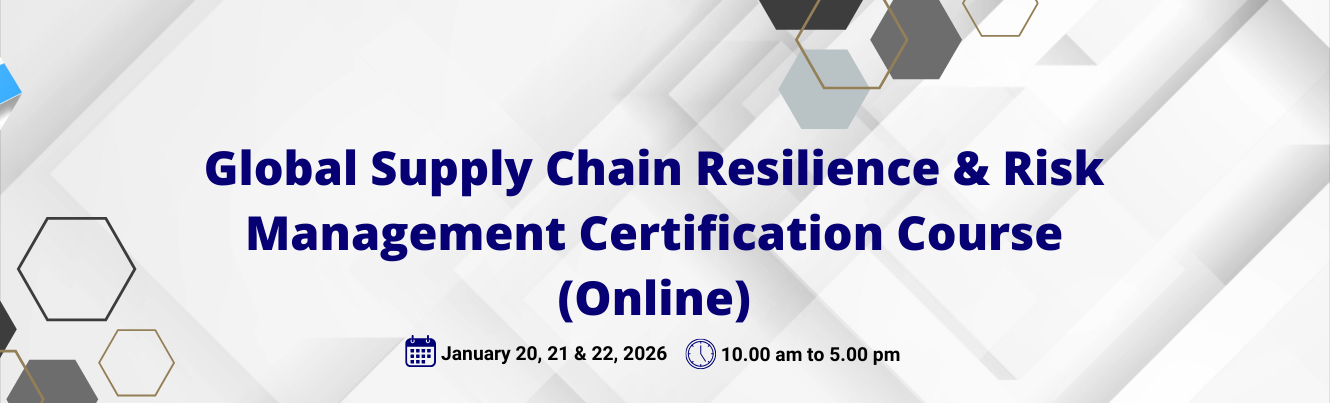
In an increasingly interconnected and volatile world, global supply chains face constant disruption from geopolitical tensions, natural disasters, pandemics, cyber threats, and market volatility. This course explores the principles and practices of supply chain resilience and risk management, equipping learners with the tools to anticipate, assess, and mitigate risks across global networks. Through real-world case studies, strategic frameworks, and analytical approaches, participants will develop the capability to design robust, agile, and sustainable supply chains that can withstand shocks while maintaining operational continuity and competitive advantage.
Contents:
Day 1
Module 1: Introduction to Global Supply Chains in a Changing World
1.1 Evolution of Global Supply Chains – From Linear to Networked Systems
1.2 The Impact of Globalization, Trade Wars, and Geopolitical Shifts
1.3 Key Drivers of Disruption: Pandemics, Climate, Cyber, and Conflict
1.4 Supply Chain Resilience vs. Efficiency: Striking the Balance
1.5 Role of Technology and Policy in Modern Supply Chain Transformation
Module 2: Supply Chain Design & Risk Identification Frameworks
2.1 Mapping the Global Supply Chain Network
2.2 Identifying and Classifying Supply Chain Risks: Strategic, Operational, and Environmental
2.3 Risk Assessment Tools and Methodologies (FMEA, PESTLE, Monte Carlo)
2.4 Supplier Risk Mapping and Multi-Tier Visibility
2.5 Scenario Planning and Simulation Modeling
Exercise:
Build a Risk Heatmap for a Multinational Manufacturing Chain
Module 3: Building Resilient and Agile Supply Chain Strategies
3.1 Principles of Supply Chain Resilience (Redundancy, Flexibility, Visibility)
3.2 Nearshoring, Friendshoring, and Multi-Sourcing Strategies
3.3 Agility through Real-Time Data and Predictive Analytics
3.4 Integrating Sustainability and ESG in Supply Chains
3.5 Policy and Government Role in Supply Chain Diversification
Discussion:
“Can India be the next global supply chain hub?”
Day 2
Module 4: Supply Chain Risk Management Frameworks
4.1 Enterprise Risk Management (ERM) for Supply Chains
4.2 Business Continuity Planning (BCP) and Disaster Recovery
4.3 Supplier Performance and Compliance Monitoring
4.4 Insurance and Financial Risk Instruments (Credit, FX, Hedging)
4.5 KPIs and Metrics for Resilience Assessment
Exercise:
Develop a BCP outline for a logistics disruption scenario
Module 5: Digital Transformation of Supply Chains
5.1 Smart Supply Chains: AI, IoT, and Robotics in Logistics
5.2 Blockchain for Traceability, Provenance, and Transparency
5.3 Cloud and API Integration for End-to-End Visibility
5.4 Digital Twins and Simulation for Risk Prediction
5.5 Predictive Maintenance and Data-Driven Decision Making
Demo:
Blockchain-based shipment traceability in cross-border trade
Module 6: Supply Chain Security, Compliance & Governance
6.1 Customs, Trade Regulations, and Compliance Frameworks
6.2 Export Controls and SCOMET in Sensitive Supply Chains
6.3 Cybersecurity in Supply Chain Networks
6.4 Ethical Sourcing, Labor Laws, and Human Rights Compliance
6.5 Governance Models for Resilient Global Supply Ecosystems
Case Study:
Supply Chain Cyber Breach (e.g., SolarWinds or Colonial Pipeline)
Day 3
Module 7: Sustainable & Green Supply Chains
7.1 ESG Integration in Global Trade and Manufacturing
7.2 Carbon Foot printing and Scope 3 Emissions Tracking
7.3 Circular Economy and Reverse Logistics
7.4 Regulatory Frameworks for Green Supply Chains (EU CBAM, ISO 20400)
7.5 Financing Green and Responsible Supply Chains
Exercise:
Design a Sustainability Action Plan for a Supply Chain
Module 8: Data Analytics & Decision Support Systems
8.1 Role of Big Data and AI in Risk Prediction
8.2 Using Digital Dashboards for Visibility and Control
8.3 Inventory Optimization and Demand Forecasting Models
8.4 Early Warning Systems and Automated Alerts
8.5 Measuring ROI on Digital Supply Chain Investments
Simulation:
AI-driven supply chain forecasting and risk mitigation game
Module 9: Future of Global Supply Chains
9.1 Geoeconomics and the New World of Strategic Dependencies
9.2 Regionalization: Indo-Pacific, EU, and Africa Trade Corridors
9.3 Supply Chain 5.0 – Human-AI Collaboration and Automation
9.4 Integration of DPI (Digital Public Infrastructure) for Logistics Enablement
9.5 Future Skills for Supply Chain Professionals
Discussion:
“Supply Chain 2030: Predicting the Next Decade of Transformation”
Module 10: Capstone Exercise & Policy Recommendations
10.1 Group Project: Build a Supply Chain Resilience Roadmap
10.2 Identify Key Technologies and Policy Enablers
10.3 Present Risk Mitigation Frameworks for Industry Use Cases
10.4 Certification & Closing Remarks
Who should attend? CXO’s and other executives in decision making positions, Managers responsible for key deliverables in large scale operations, Exporters and importers.
Trainer Profile: Ujjwal Basu – Business Strategic Specialist
23+ years of learning in Commercial negotiations, Procurement, Vendor Management, Supply Chain, Production Planning, Logistics, Purchasing, Warehousing, Sales and after sales. Domestic and Global, Lead – Asia Pacific team, exposure to Middle east, EU and US. Worked in varied Industries – Automobile, Media, ITES, Chemicals, Logistics, FMCG and Other Manufacturing. Worked in various Green and Brown field projects. Currently working as Business Consultant with Multiple organizations.
A highly impactful Strategic specialist, with diversified experience in Integrated Supply Chain Management and International Business acumen with various Industry knowledge viz. Automobile, Media, ITES, Chemicals, Green Mobility, Supply Chain and Other Manufacturing organizations having over two decades of experience in the field of Sourcing Management, Logistics, Value Chain, Inventory Management, Plant Operations, Production Planning, Brand, Customer Relationship Management and handling multiple green field projects. Experience of handling Domestic, Asia Pacific, Middle East and US territories. Worked in top Indian and Global brands like ABP Pvt Ltd, General Motors India, Tata Motors, Avaya India, Johnson Matthey India, Fogla Corp. Contributed in business strategy formulation and achieving volumetric business growth, business process reengineering and change management, supplier consolidation and cost optimization.