




 Login
Login
An employee cannot be compelled to deposit the amount of retrenchment compensation as a condition for challenging his retrenchment-Bom HC
Blog
An employee cannot be compelled to deposit the amount of retrenchment compensation as a condition for challenging his retrenchment-Bom HC
An employee cannot be compelled to deposit the amount of retrenchment compensation as a condition for challenging his retrenchment.
Judgement attached
Bids-2
Ref.: MCM/ADM/11 26 September 2025
The Director General
Bombay Chamber of Commerce and Industry
Mackinnon Mackenzie Building
3rd floor, 4, Shoorji Vallabhdas Road
Ballard Estate, Mumbai – 400 001
Dear Sir/Madam,
Invitation for Bids
Please see enclosed notices for invitation for bids from organizations in Mauritius.
Prospective bidders may be requested to regularly visit the website to take cognizance of any addendum and/or clarification(s) issued.
The Consulate would highly appreciate if you could kindly circulate the Notices among the members of your Organization.
Thank you for your understanding and cooperation.
Yours sincerely,
D. K. Bucktowar
Consul and Head of Mission
Consulate of the Republic of Mauritius
1107, Regent Chambers
11th Floor, Jamnalal Bajaj Marg
208, Nariman Point
Mumbai – 400 021
Tel. : 022 22825421 /22
Fax No. 022 22845468
Millions of MSME workers remain uninsured, reveals new data from NI-MSME
Millions of MSME workers remain uninsured, reveals new data from NI-MSME

Mumbai: Despite employing over 110 million people across India, micro, small and medium enterprises (MSMEs) continue to fall short in providing basic health protection to their workforce. New data from the National Institute for Micro, Small and Medium Enterprises (NI-MSME) shows that fewer than one in 10 MSMEs offer group health insurance to employees, a figure that underscores a significant gap in workplace benefits across the sector.
The findings are particularly concerning given the scale of the MSME ecosystem, which comprises more than 63 million enterprises nationwide. While group health insurance is often the first and only form of coverage for salaried workers, most MSME employees remain uninsured, especially those in informal or unregistered businesses. This leaves millions vulnerable to medical emergencies without financial support from their employer.
The adoption of group health insurance is highest in urban, Tier 1 service sectors such as information technology and financial services. In contrast, industries with higher physical risk – including manufacturing, construction and retail – show markedly lower coverage rates. Micro and small enterprises are the least likely to offer any form of employee insurance, according to the NI-MSME data.
Several factors contribute to this low uptake. Cost remains a primary concern, with many small business owners assuming that group insurance is prohibitively expensive or only viable for larger firms. There is also a widespread lack of awareness about affordable, customisable plans now available in the market.
Digitisation plays a role too, MSMEs that operate offline are less likely to engage with digital insurance platforms that simplify enrolment and claims. Crucially, there is no regulatory mandate requiring MSMEs to provide group health insurance, unlike schemes such as the Employees’ State Insurance Corporation (ESIC) or Provident Fund.
However, the landscape is beginning to shift. Insurers and fintech companies have introduced bite-sized group health plans tailored for small teams, with premiums starting as low as ₹100 to ₹150 per employee per month. These plans often include features such as zero paperwork, instant onboarding, and optional add-ons like outpatient cover or teleconsultation services. The Insurance Regulatory and Development Authority of India (IRDAI) has also encouraged insurers to design simplified group products specifically for micro and small businesses.
Some state governments are exploring incentives to boost adoption, including GST waivers and partial premium contributions. These efforts aim to make health insurance more accessible and relevant for MSMEs, aligning with broader national goals around universal health coverage and financial inclusion.
The implications for workers are significant. Without employer-sponsored insurance, many MSME employees face delays in seeking treatment due to cost concerns. Group plans typically offer advantages such as no medical checks, maternity cover, mental health support and lower premiums compared to individual policies – benefits that are often out of reach for those without formal employment benefits.
According to industry estimates, only eight to 10 million MSME employees are currently covered by group health plans. This represents a small fraction of the total workforce, and highlights the urgency of expanding coverage across the sector. With roughly 90 per cent of MSMEs operating informally and outside the purview of labour regulations, the challenge is not only financial but structural.
As India continues to push for inclusive growth, the MSME sector remains a critical focus area. Addressing the health insurance gap will require coordinated efforts from policymakers, insurers and industry bodies. For employers, the availability of flexible, low-cost plans presents an opportunity to enhance workplace security. For employees, initiating conversations around coverage could be the first step toward better protection.
The data paints a clear picture that health insurance is no longer a corporate luxury but a workplace necessity. Bridging the coverage gap in MSMEs is not just a matter of policy, but of equity and resilience.
(Write to us at editorial@bombaychamber.com)
Union Cabinet approves ₹69,725 crore to revive shipbuilding sector
Union Cabinet approves ₹69,725 crore to revive shipbuilding sector
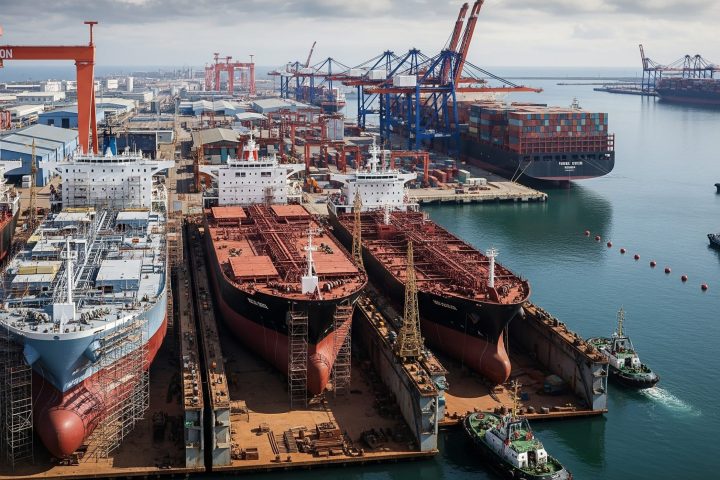
Mumbai: In a major policy move aimed at revitalising the country’s maritime capabilities, the Union Cabinet has approved a ₹69,725 crore package to strengthen India’s shipbuilding and maritime infrastructure. The decision marks one of the most substantial investments in the sector to date and reflects a strategic shift toward enhancing domestic capacity, long-term financing, and technical expertise.
The package is built around a four-pillar framework that includes extending financial assistance for shipbuilding, establishing dedicated maritime funds, expanding shipyard infrastructure, and implementing legal and policy reforms. At the heart of the initiative is the extension of the Shipbuilding Financial Assistance Scheme (SBFAS) until 31 March 2036, with a corpus of ₹24,736 crore. The scheme is designed to incentivise domestic shipbuilding and includes a ₹4,001 crore allocation for Shipbreaking Credit Notes, aimed at supporting environmentally responsible dismantling of vessels.
A National Shipbuilding Mission will be set up to oversee the implementation of these measures, ensuring coordination across ministries and stakeholders. The Cabinet also approved the creation of a Maritime Development Fund (MDF) with a total corpus of ₹25,000 crore. This includes a ₹20,000 crore Maritime Investment Fund, in which the government will hold a 49 per cent stake, and a ₹5,000 crore Interest Incentivisation Fund to reduce the cost of debt and improve the viability of maritime projects.
The Shipbuilding Development Scheme (SbDS), with an outlay of ₹19,989 crore, is expected to expand India’s shipbuilding capacity to 4.5 million Gross Tonnage annually. It will support the development of mega shipbuilding clusters, infrastructure upgrades, and the establishment of the India Ship Technology Centre under the Indian Maritime University. The scheme also includes provisions for insurance and risk coverage to support shipbuilding ventures.
Taken together, the measures are projected to generate nearly 30 lakh jobs and attract investments of approximately ₹4.5 lakh crore into the maritime sector. The government expects the initiative to enhance national, energy, and food security by strengthening supply chain resilience and maritime logistics. It also aims to bolster India’s strategic autonomy in the Indo-Pacific region, where maritime infrastructure plays a critical role in geopolitical stability.
India’s maritime sector currently handles about 95 per cent of the country’s trade by volume and 70 per cent by value. Despite this centrality, domestic shipbuilding has struggled to compete globally due to limited financing options, outdated infrastructure, and policy bottlenecks. The new package seeks to address these structural challenges by offering targeted financial support and institutional reforms.
The emphasis on long-term financing through the MDF and the Maritime Investment Fund is particularly significant. Historically, the lack of affordable credit has been a major impediment to shipyard expansion and fleet modernisation. By reducing the effective cost of debt, the government hopes to make Indian shipbuilding projects more bankable and attractive to private investors.
The establishment of the India Ship Technology Centre is another key element of the package. It is expected to serve as a hub for research, innovation, and skill development, helping to build a technically proficient workforce and promote indigenous design capabilities. This aligns with broader efforts to reduce reliance on foreign technology and improve the competitiveness of Indian shipyards.
The Cabinet’s decision comes at a time when global shipping is undergoing rapid transformation, driven by digitalisation, decarbonisation, and shifting trade routes. India’s ability to adapt to these changes and position itself as a reliable shipbuilding hub will be critical to the long-term viability of the sector.
(Write to us at editorial@bombaychamber.com)
Extension of Invitations for Bids (IFB) –Ceylon Petroleum Corporation Bid No. – B/21/2025
My No. MUM/TRD/TENDERS
Mr. Sandeep Khosla
Director General
Bombay Chamber of Commerce & Industry
Dear Mr. Sandeep Khosla,
Extension of Invitations for Bids (IFB) –Ceylon Petroleum Corporation
Bid No. – B/21/2025 – Construction of A Jet A-1 Transfer Pipeline From Muthurajawela to BIA Katunayake and Construction of Jet A-1 Storage Tanks and Associated Facilities with Modifications to the Existing Terminal Facility at Muthurajawela
This is further to email of 28th July 2024 on the above. I wish to inform you that the Chairman, High Level Procurement Committee (HLPC) on behalf of Ceylon Petroleum Corporation (CPC) has extended the deadline of submission of bids for the project “Construction of A Jet A-1 Transfer Pipeline From Muthurajawela to BIA Katunayake and Construction of Jet A-1 Storage Tanks and Associated Facilities with Modifications to the Existing Terminal Facility at Muthurajawela”.
The extended closing date for the submission of above IFB is on 17th October 2025 at 1400 hrs (Sri Lanka local time GMT+5:30).
Please find attached herewith a copy of the notice of the above.
It would be appreciated, if you could kindly make necessary arrangements to disseminate the same among your membership.
With warm regards,
Shirani Ariyarathne
Consul
Consulate General of Sri Lanka
34, Homi Mody Street, Fort
Mumbai 400001
Tel: (+ 91 22 )22045861/22048303
Fax: (+ 91 22) 22876132
E -mail: slcg.mumbai@mfa.gov.lk
Procurement Notice–State Pharmaceuticals Corporation of Sri Lanka
My No. MUM/TRD/TENDERS
Mr. Sandeep Khosla
Director General
Bombay Chamber of Commerce & Industry
Dear Mr. Sandeep Khosla,
Procurement Notice–State Pharmaceuticals Corporation of Sri Lanka
I wish to inform you that the Chairman, Departmental Procurement Committee of the State Pharmaceuticals Corporation of Sri Lanka has invited sealed bids for supply of following items to the Ministry of Health.
| Bid Number | Closing Date & Time | Item Description | Non – refundable Bid Fee (LKR) |
| DHS/SS/WW/163/25 | 13.10.2025 at 09.00 a.m. | Permanent Pacemaker | 3,000/- + tax |
| DHS/SA/WW/201/25 | 14.10.2025 at 09.00 a.m. | Drill Bits Locking Heads Screws | 3,000/- + tax |
Please find attached herewith a copy of the procurement notices of the above.
It would be appreciated, if you could kindly make necessary arrangements to disseminate the same among your membership.
With warm regards,
Shirani Ariyarathne
Consul
Consulate General of Sri Lanka
34, Homi Mody Street, Fort
Mumbai 400001
Tel: (+ 91 22 )22045861/22048303
Fax: (+ 91 22) 22876132
E -mail: slcg.mumbai@mfa.gov.lk
Procurement Notice–State Pharmaceuticals Corporation of Sri Lanka
My No. MUM/TRD/TENDERS
Mr. Sandeep Khosla
Director General
Bombay Chamber of Commerce & Industry
Dear Mr. Sandeep Khosla,
Procurement Notice–State Pharmaceuticals Corporation of Sri Lanka
I wish to inform you that the Chairman, Ministry Procurement Committee of the Ministry of Health has invited sealed bids for supply of following items to the Department of Health Services.
| Bid Number | Closing Date & Time | Item Description | Non – refundable Bid Fee (LKR) |
| DHS/M/SA/WW/07/26 | 08.10.2025 at 11.00 a.m. | Endoscopy Accessories and Consumables | 60,000/- + tax |
Please find attached herewith a copy of the procurement notices of the above.
It would be appreciated, if you could kindly make necessary arrangements to disseminate the same among your membership.
With warm regards,
Shirani Ariyarathne
Consul
Consulate General of Sri Lanka
34, Homi Mody Street, Fort
Mumbai 400001
Tel: (+ 91 22 )22045861/22048303
Fax: (+ 91 22) 22876132
E -mail: slcg.mumbai@mfa.gov.lk
Invitations for Bids – SriLankan Catering Ltd. Ref. No. SLC/PRO/SER/2025/006
My No. MUM/TRD/TENDERS
Mr. Sandeep Khosla
Director General
Bombay Chamber of Commerce & Industry
Dear Mr. Sandeep Khosla,
Invitations for Bids – SriLankan Catering Ltd.
Ref. No. SLC/PRO/SER/2025/006 – Inviting Bids for Professional Audit and Assurance Services for the Five Year Business Plan for Establishing an Inflight Catering Operation in Melbourne, Australia
I wish to inform you that, SriLankan Catering Ltd. has invited bids for the following;
| No. | Ref. No | Item Description | Closing Date & Time |
| 1. | SLC/PRO/SER/2025/006 | Inviting Bids for Professional Audit and Assurance Services for the Five Year Business Plan for Establishing an Inflight Catering Operation in Melbourne, Australia | 07th October 2025 at 10.00 am (Sri Lanka local time GMT+5:30). |
Please find attached herewith a copy of the bid document of the above.
It would be appreciated, if you could kindly make necessary arrangements to disseminate the same among your membership.
With warm regards,
Shirani Ariyarathne
Consul
Consulate General of Sri Lanka
34, Homi Mody Street, Fort
Mumbai 400001
Tel: (+ 91 22 )22045861/22048303
Fax: (+ 91 22) 22876132
E -mail: slcg.mumbai@mfa.gov.lk
Invitations for Bids (IFB) – Ceylon Petroleum Corporation Bid Reference No.: B/27/2025
Invitations for Bids (IFB) – Ceylon Petroleum Corporation
Bid Reference No.: B/27/2025 – Time Charter of Maintenance and Emergency Response Vessel (MERV) for Ceylon Petroleum Corporation
I wish to inform you that the Chairman, High Level Procurement Committee (HLPC) on behalf of Ceylon Petroleum Corporation (CPC) has invited sealed bids from eligible and qualified foreign and local ship owners, demise Charterers, shipbrokers, ship managers, local and foreign ship agents & representative, for the Time Chartering of a vessel, for Maintenance and Emergency Response Work connected with SPBM facility, for the period of Forty-eight (48) months commencing 1000 hrs on 01.012.2025.
Closing date for the submission of above IFB is on 24th September 2025 at 1400 hrs (Sri Lanka local time GMT+5:30).
Please find attached herewith a copy of the notice of the above.
It would be appreciated, if you could kindly make necessary arrangements to disseminate the same among your membership.
Thank you.
With warm regards,
Shirani Ariyarathne
Consul
Consulate General of Sri Lanka
34, Homi Mody Street, Fort
Mumbai 400001
Tel: (+ 91 22 )22045861/22048303
Fax: (+ 91 22) 22876132
E -mail: slcg.mumbai@mfa.gov.lk
Invitation for Expression of Interest (EOI) – Ministry of Industry and Entrepreneurship Development
Invitation for Expression of Interest (EOI) – Ministry of Industry and Entrepreneurship Development
Assignment No. MI/FIN/35/29/01 – Implementation of the Value Addition Project for Rock Phosphate Mined by Lanka Phosphate Limited under the Public Private and People Partnership (PPPP) Method
I wish to inform you that, the Ministry of Industry and Entrepreneurship Development, has Expression of Interest (EOI) from qualified organizations for the Implementation of the Value Addition Project for Rock Phosphate Mined by Lanka Phosphate Limited under the Public Private and People Partnership (PPPP) Method.
Closing date for the above is on or before 02.00 pm on 02nd October 2025 (Sri Lanka Standard Time, (GMT+5:30)).
Please find attached herewith a copy of the notice of the above EOI.
It would be appreciated, if you could kindly make necessary arrangements to disseminate the same among your membership.
Thank you.
With warm regards,
Shirani Ariyarathne
Consul
Consulate General of Sri Lanka
34, Homi Mody Street, Fort
Mumbai 400001
Tel: (+ 91 22 )22045861/22048303
Fax: (+ 91 22) 22876132
E -mail: slcg.mumbai@mfa.gov.lk