
Saturday, September 5, 2026
Blog

 Login
Login
January 21, 2026
The Banking Conclave 3.0: Future of Banking, organised by the Bombay Chamber of Commerce & Industry, brought together senior bankers, policymakers, fintech leaders, and financial services experts to deliberate on how India’s banking system must evolve to remain resilient, inclusive, and future-ready. Held at the ITC Grand Central Hotel, Mumbai, the conclave examined the structural, technological, and regulatory shifts shaping the next decade of banking.
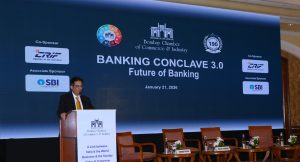
In his Welcome Address, Sandeep Khosla, Director General, Bombay Chamber of Commerce & Industry, highlighted the Chamber’s long-standing role as a neutral facilitator and an effective bridge between industry and government, fostering constructive dialogue on policy, regulation, and economic priorities. He noted that as the banking and financial services sector navigates rapid technological change, consolidation, and evolving regulatory expectations, such platforms play a critical role in aligning industry perspectives with public policy objectives. Emphasising the Chamber’s commitment to convening thought leadership and enabling informed discourse, he underscored the importance of collaborative engagement to ensure that India’s banking system remains resilient, inclusive, and future-ready.
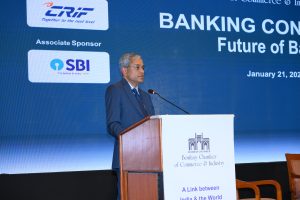
Delivering the Keynote Address, Rajiv Anand, President, Bombay Chamber and Managing Director & CEO, IndusInd Bank, offered a compelling perspective on the structural transformation underway in global and Indian banking. He observed that the industry is moving beyond a phase where incremental improvements, isolated digital initiatives, or marginal efficiency gains are sufficient to remain relevant. Instead, banking is being reshaped by deeper shifts in how value is created, how trust is earned, and how institutions engage with society.
Anand noted that while banks have traditionally been defined by balance sheets, capital adequacy, branch networks, and regulatory classifications, these dimensions alone are no longer adequate in a world reorganised by technology, data, and changing customer expectations. He emphasised that India’s unique advantage lies in its digital public infrastructure, which has fundamentally altered how citizens participate in the economy. Platforms such as Aadhaar, UPI, Account Aggregator, and the JAM trinity (Jan Dhan–Aadhaar–Mobile) have not merely digitised financial services, but have embedded finance into everyday life, lowered transaction friction, expanded access, and strengthened trust at population scale.
Highlighting India as one of the few countries to have built such infrastructure deliberately and at scale in a short period of time, Anand stressed that technology alone does not transform societies—it only enables transformation. He called upon banks to view themselves not merely as providers of financial products, but as stewards of economic participation, supporting mobility, productivity, and long-term growth. He pointed to the rapid formalisation of enterprises, the digitisation of financial behaviour, the rise of first-generation entrepreneurs, and a young, mobile-first population as defining features of India’s next growth phase.
At the same time, Anand acknowledged that despite progress, credit penetration remains modest, large segments of MSMEs remain underserved, and many households remain vulnerable to income shocks and uncertainty. He underscored the need to rethink how capital is allocated, how risk is assessed, and how customer journeys are designed. He cautioned that merely replicating old banking models on new digital platforms will not deliver meaningful transformation.
He further noted that banking institutions have historically been organised around products—deposits, loans, insurance, and investments—whereas customers experience finance through life goals such as building livelihoods, growing businesses, educating children, caring for families, and preparing for the future. Anand stressed that banks that continue to prioritise internal product structures over customer outcomes risk losing relevance in an increasingly aspiration-driven economy.
Addressing the role of emerging technologies, Anand observed that artificial intelligence represents a fundamental shift—not simply in automation, but in how decisions are made, patterns are detected, risks are assessed, and systems are managed. He emphasised that the future of banking will belong to institutions that combine technological capability with ethical foundations, regulatory responsibility, and a long-term partnership approach to customers.
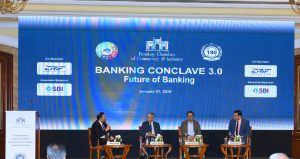
The first panel discussion, “Changing Face of Banking,” examined how technology, data analytics, and new-age players are redefining the banking landscape. Moderated by Yashraj Erande, India Leader – Financial Services and Global Leader – Fintech, Boston Consulting Group, the panel featured Rajiv Anand, Anirban Mukherjee, CEO, PayU, and Sachin Seth, Regional Managing Director, India and South Asia, CRIF. The discussion focused on the convergence of banks and fintechs, the growing role of alternative data in credit assessment, and the shift towards embedded finance and platform-based banking models.
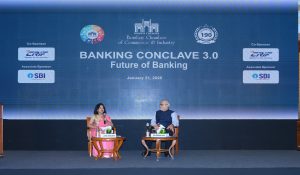
A key highlight of the conclave was the Fireside Discussion on “The Bank of 2030,” featuring Shri Rajeshwar Rao, Former Deputy Governor, Reserve Bank of India, in conversation with Latha Venkatesh, Executive Editor, CNBC-TV18. The discussion focused on how banks must navigate a rapidly evolving financial ecosystem marked by digital disruption, changing liability structures, the growing role of non-bank players, and increasing interlinkages across the financial system. Shri Rao emphasised the need to balance innovation with stability, underscoring the importance of sound governance, robust risk management, adequate capital and liquidity, and a regulatory framework that remains flexible while safeguarding systemic trust. The conversation offered a forward-looking regulatory perspective on consolidation, competition, and resilience in a technology-driven banking landscape.
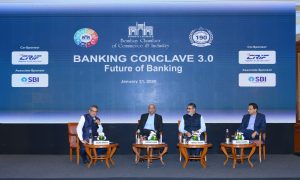
The second panel, “Consolidation and Regulation in Banking,” moderated by Abizer Diwanji, Founder, NeoStrat Advisors LLP, featured Prashant Kumar, MD & CEO, YES BANK, Neeraj Makin, Senior Executive Vice President & Group Head – Strategy, Analytics & Venture Capital, Emirates NBD, and Anshul Agarwal, Managing Director and Head – Financial Institutions Group (FIG), Avendus Capital. The panel examined consolidation as a strategic response to scale, competitiveness, and regulatory demands, while underscoring the importance of governance, capital strength, and institutional integration.
The conclave concluded with a Vote of Thanks by Sandeep Khosla, followed by networking. Banking Conclave 3.0 reaffirmed the Bombay Chamber’s role as a convenor of meaningful dialogue between industry and policymakers, and offered a forward-looking perspective on how Indian banking must evolve to serve a dynamic, diverse, and rapidly transforming economy.