


Blog


 Login
Login
Bombay Chamber, Mumbai: India must move decisively to scale up shipbuilding capacity, deepen financial ecosystems and accelerate the green transition to emerge as a global maritime powerhouse. This was the underlying theme at the Global Harit Nauka Summit: Trust, Collaborate, Impact, organised by the Bombay Chamber of Commerce and Industry on February 24, 2026, at ITC Grand Central Hotel, Mumbai.
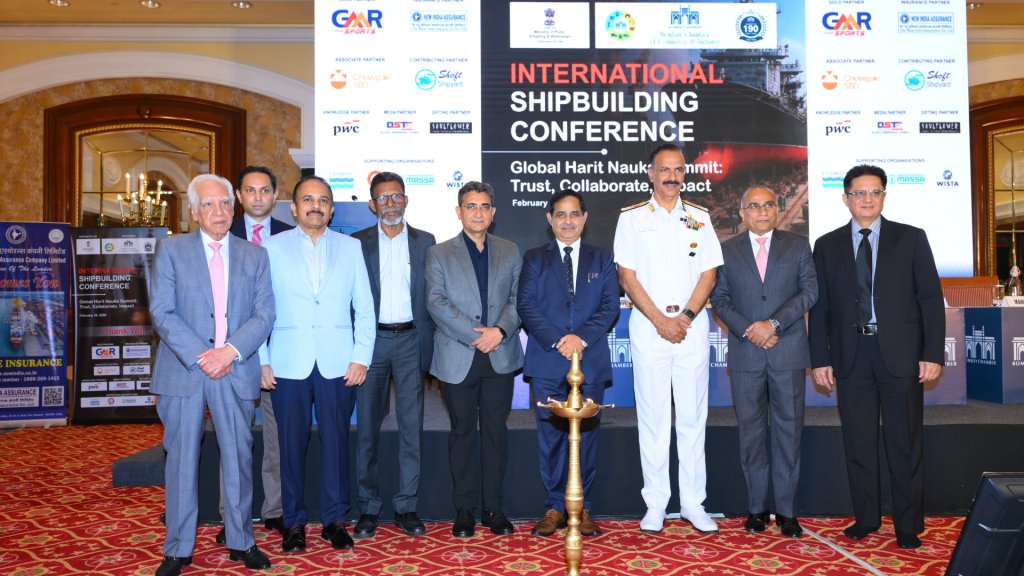
The International Shipbuilding Conference brought together senior government officials, naval leadership, shipyard heads, financiers, insurers and global maritime stakeholders to chart India’s pathway towards becoming a top-five shipbuilding nation by 2047.
In his keynote address on Shaping a Globally Competitive and Sustainable Shipbuilding Ecosystem: India’s Path Forward, Shri Shyam Jagannathan, IAS, Director General, Directorate General of Shipping, Ministry of Ports, Shipping and Waterways, Government of India, outlined the strategic and regulatory roadmap for India’s maritime growth. Noting that India is now a $4.19 trillion economy and the world’s fourth largest, he highlighted that 95% of India’s trade by volume and 70% by value moves by sea, making shipbuilding central to economic security.
Referring to geopolitical disruptions in the Red Sea and Black Sea regions and shifting global trade routes, he stressed the importance of strengthening domestic shipbuilding to secure supply chains and strategic autonomy. Under Maritime India Vision 2030 and Maritime Amrit Kaal Vision 2047, India aims to enter the top 10 shipbuilding nations by 2030 and the top 5 by 2047, scaling annual production significantly while generating large-scale employment.
Shri Jagannathan detailed the government’s four-pillar approach: the Shipbuilding Financial Assistance Scheme, the Shipbuilding Development Scheme, the Maritime Development Fund and comprehensive legal and process reforms, backed by a ₹69,725 crore policy framework. He underlined the impact of the Merchant Shipping Act, 2025 and the Coastal Shipping Act, 2025 in modernising maritime governance, streamlining vessel registration and promoting Indian-flagged tonnage. He also highlighted green vessel incentives, ship recycling reforms and opportunities emerging from GIFT City as a competitive ship leasing and maritime finance hub.
Delivering the special address on “Shipbuilding as a Strategic Driver of India’s Maritime Vision,” Arjun Chowgule, Managing Director, Chowgule Group, emphasised that shipbuilding must be viewed as a strategic enabler of trade security, naval strength and industrial self-reliance, calling for long-term policy visibility and stronger public-private collaboration.
Earlier, Sudhanshu Vats, Sr. Vice President, Bombay Chamber and Managing Director, Pidilite Industries, welcomed delegates and underscored the Chamber’s long standing engagement with the maritime sector.
Setting the theme, Shri Rajiv Jalota, Former IAS, Former Chairman of Mumbai Port Authority and DG Shipping, Government of India, and Conference Chairman, underscored that shipbuilding sits at the intersection of trade competitiveness, energy security, national security, technology leadership and climate responsibility. He outlined three global forces shaping the next shipbuilding cycle — fleet renewal, decarbonisation and geopolitical resilience — and stressed that green shipbuilding must be viewed as a full ecosystem spanning engines, fuel systems, fabrication, digital planning, classification, repair capacity and skilled manpower. He called for stable multi-year policy support, industrial-scale production, innovative financing and demand visibility to achieve the ambition of becoming a top-five shipbuilding nation by 2047.
Manish Sharma, Partner and Leader, Infrastructure, Transport and Logistics, PwC India, presented key recommendations from an industry survey, highlighting supply-side constraints, financing gaps and the need for cluster-based expansion.
The session on Shipbuilding in a Shifting World: India’s Role in the Indo-Pacific was moderated by Mohanlal Pillai, CEO, Mech Marine Engineers. The panel featured Vice Admiral Ankur Sharma, Admiral Superintendent (ASD), Naval Dockyard Mumbai; Arjun Chowgule, Managing Director, Chowgule Group; Vishal Kanwar, Partner, PwC India; and Sapna Dipu, AGM (Forward Design & Contracts), Mazagon Dock Shipbuilders. The discussion examined shipbuilding as a pillar of maritime security, Indo-Pacific trade and naval collaboration, global competition and technology transfer opportunities.
The subsequent session on “Financing Shipyards, Technology, and Infrastructure: Unlocking Supply-Side Growth” was moderated by K. Mukundan, Senior Principal – Strategic Initiatives and Policy Advisory, National Investment and Infrastructure Fund (NIIF). Panelists included Rajeev Nayyer, Advisor, Swan Defence & Heavy Industries; Sachin Kulkarni, Head – Marine Business Sales (South Asia), Wärtsilä India; Naveen Rawat, GM (PF&S SBU), State Bank of India; and Jayati Roy, Deputy General Manager, Aviation, Marine Hull & Marine Cargo Technical Department, The New India Assurance Co. The panel highlighted blended finance structures, PPP models, insurance-backed risk mitigation and green finance tools as essential enablers for capacity expansion.
A special address on Collaborating for a Sustainable Maritime Future was delivered by Daiyu Kurachi, Technical Group, NYK Line, who shared perspectives on Japan’s green shipping initiatives and collaboration opportunities with India.
A key highlight of the afternoon was the panel on Financing Fleet Expansion: Meeting Global & Domestic Shipping Demand, chaired by Capt. B. K. Tyagi, Chairman & Managing Director, Shipping Corporation of India, and moderated by Anil Radhakrishnan, CEO, GMR Enterprises and Director, Bombay Chamber. Panelists included Anil Devli, CEO, Indian National Ship Owners Association; Pallavi Raje, Executive Director – Transportation Finance, Standard Chartered Bank; and Pravin Kirolikar, CEO, Yeoman Marine Services. The discussion explored innovative ship leasing and bareboat charter models, financing mechanisms for LNG, methanol and hydrogen-powered vessels, and the use of cargo-backed long-term contracts as risk mitigation tools, with particular emphasis on the role of GIFT City in ship financing.
Girija Subramanian, Chairman-cum-Managing Director, The New India Assurance Co. Ltd., delivered a special address highlighting the evolving role of marine insurance in supporting fleet modernisation and mitigating emerging risks in a dynamic global shipping environment.
The session on “Building Human Capital for a Competitive Shipbuilding Industry,” chaired by Dr. (Mrs.) Malini V Shankar, IAS (Retd.), Vice Chancellor, Indian Maritime University, was moderated by Capt. Hemant Gupta, Deputy Director, Drewry Maritime Advisors. Panel members included Uday Chaitanya Ganivada, Country Manager – India, Sri Lanka & Bangladesh, DNV; Sahay Raj, Managing Director, Shoft Shipyard and P. K. Mishra, Managing Director, Indian Register of Shipping. The discussion focused on advanced skills, industry–academia partnerships, employment generation and strengthening India’s maritime talent pipeline.
The valedictory session on “Policy to Practice: How State Clusters/Maritime Boards can Anchor India’s Global Shipbuilding Ambitions” featured addresses by Mr. Kalpesh Vithlani, Gujarat Maritime Board; Capt. Dharma Sastha, Andhra Pradesh Maritime Board; Mr. Prabakaran, Associate Vice President, Guidance Tamil Nadu; and Capt. Praveen Khara, Chief Port Officer, Maharashtra Maritime Board.
The summit concluded with a call for coordinated action across policy, finance, technology and skills development to ensure India leverages its shipbuilding capabilities, strategic location and reform momentum to build a resilient, green and globally competitive maritime ecosystem.