
Saturday, September 5, 2026
Blog

 Login
Login
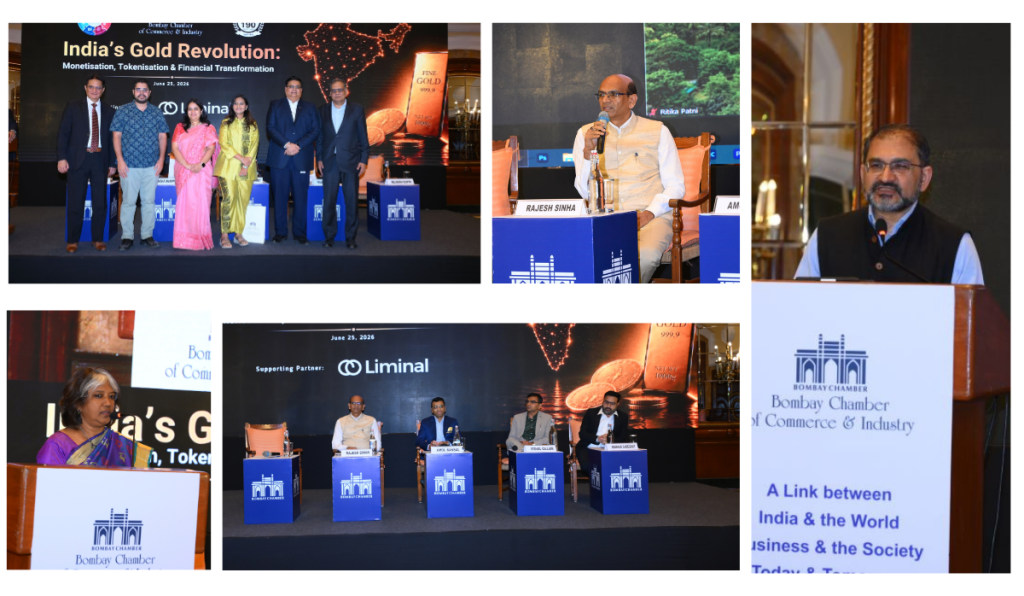
Mumbai, June 25, 2026: With Indian households holding nearly 34,600 tonnes of gold valued at approximately US$3.8 trillion, the Bombay Chamber of Commerce & Industry convened leading policymakers, regulators, market infrastructure institutions and industry experts to deliberate on how the country’s vast gold reserves can be transformed from idle wealth into an active driver of economic growth.
The conclave, “India’s Gold Revolution: Monetisation, Tokenisation & Financial Transformation,” examined the reforms, technologies and market innovations needed to unlock the economic value of India’s gold holdings while reducing dependence on imports and strengthening the country’s financial ecosystem.
Delivering the welcome address, Ashith Kampani, Chair – PE & VC Committee, Bombay Chamber of Commerce & Industry and Chairman, CosmicMandala15 Securities, highlighted the paradox at the heart of India’s gold economy.
“India possesses one of the world’s largest repositories of privately held gold wealth, yet continues to remain among the largest importers of the precious metal. The challenge before us is not whether India should own gold, but how we can transform gold from a passive store of wealth into an active financial asset that contributes more effectively to economic growth, capital formation and financial inclusion,” he said.
Kampani observed that while gold monetisation has long been a policy priority, participation has remained limited because gold ownership in India is deeply personal and emotional. Concerns around purity assessment, valuation, liquidity and trust have prevented large-scale adoption.
He noted, however, that India is now at a pivotal moment, with digital public infrastructure, maturing financial markets, blockchain technology and tokenisation creating unprecedented opportunities to modernise the gold ecosystem.
“The future of gold in India may no longer be defined solely by physical possession. It may increasingly be characterised by digital ownership, fractional participation, transparent custody and seamless integration with broader financial markets,” Kampani said.
Delivering the keynote address on “Building India’s Digital Gold Infrastructure,” Praveena Rai, Managing Director & CEO, MCX, stressed the urgent need to financialise India’s gold holdings.
She pointed out that after crude oil, gold remains India’s second-largest import, accounting for nearly US$72 billion annually, making the issue significant not only for investors but also for the country’s macroeconomic stability.
“The question before us is how we create true financialisation of gold. A substantial portion of the nearly 30,000 tonnes of gold held across Indian households is maintained primarily as an investment asset. The opportunity lies in bringing this gold into highly active financial instruments that allow investors to participate confidently while enabling the economy to benefit from this enormous pool of wealth,” Rai said.
She highlighted the growing range of regulated financial products available to investors, including Electronic Gold Receipts (EGRs), Gold Exchange Traded Funds (ETFs) and Exchange Traded Commodity Derivatives (ETCDs).
While Electronic Gold Receipts hold immense promise by enabling physical gold to be converted into tradeable securities, Rai noted that certain policy issues, particularly around GST, have slowed their adoption. She urged industry bodies, including the Bombay Chamber, to contribute towards resolving these challenges.
Rai also highlighted the remarkable growth of Gold ETFs, noting that for the first time, gold accounted for nearly 55 percent of ETF inflows in India, reflecting increasing investor confidence in regulated digital investment avenues.
She emphasised that India’s commodity derivatives market has matured significantly, with MCX recording average daily trading volumes of approximately ₹2.2 lakh crore in gold futures and options, providing robust liquidity and efficient price discovery.
A major milestone, she said, came in March 2026 when SEBI permitted Indian exchange prices to be used for valuation of mutual fund assets under management, enabling domestic benchmarks to gain greater credibility.
“As the world’s second-largest consumer of gold, India must progressively develop its own globally recognised pricing benchmarks rather than depending solely on international reference prices,” Rai observed.
She further underlined the importance of adopting Indian Good Delivery standards to encourage gold recycling, thereby reducing dependence on imports and supporting the development of a circular gold economy. Looking ahead, Rai identified digital distribution, regulated infrastructure and tokenisation as the next frontier for India’s gold ecosystem.
“Technology alone is not enough. Innovation must be built on a strong regulatory foundation. Tokenisation offers exciting possibilities, but it must work alongside regulated financial infrastructure, digital distribution channels and policy reforms. Together, these can become game changers for India’s gold economy,” she said.
The conclave featured two high-level panel discussions.
The first panel discussion, “Building India’s Gold Monetisation Marketplace,” was moderated by Neil Borate, Editor-in-Chief, thefynprint, and featured Richa Agarwal, Chief General Manager, Securities and Exchange Board of India (SEBI); Ramakrishnan Padmanabhan, General Manager, Department of Metals & Commodities, International Financial Services Centres Authority (IFSCA); Khushboo Ranawat, Regional Chairman – Western Region and Member, National Exhibition Sub-Committee, Gem & Jewellery Export Promotion Council (GJEPC); Nilesh Lodaya, Chief Business Officer, Central Depository Services Limited (CDSL); and Rajnish Gupta, Partner, Tax and Economic Policy Group, EY India. The panellists deliberated on the regulatory, taxation and market infrastructure reforms required to build a robust and scalable gold monetisation marketplace in India.
The second panel discussion, “Moving Gold Monetisation onto the Blockchain,” was moderated by Rajesh Sinha, Partner, Innoqbate Ventures, and featured Amol Bansal, Founder & CEO, MyGold; Vishal Gajjar, Senior Vice President, National Securities Depository Limited (NSDL); Ritika Patni, Head – Singapore Office and NDA Lead, Global Strategic Legal Consulting, Nishith Desai Associates; Manhar Garegrat, Senior Vice President and Country Head – India, Liminal Custody; Hiren Chandaria, Managing Director, Middle East and Asia Operations, Monetary Metals & Co.; and Harshit Gupta, Head – Digital Consumer Business, MMTC-PAMP India. The discussion explored how blockchain, tokenisation, digital custody and emerging technologies can transform gold ownership, improve transparency and create new investment opportunities within a secure and regulated framework.
The conclave concluded with a Vote of Thanks delivered by Sandeep Khosla, Director General, Bombay Chamber of Commerce & Industry, who expressed gratitude to the distinguished speakers, panellists, industry leaders, regulators and participants for their valuable insights and contributions towards shaping the future of India’s gold ecosystem.