
Saturday, September 5, 2026
Blog

 Login
Login
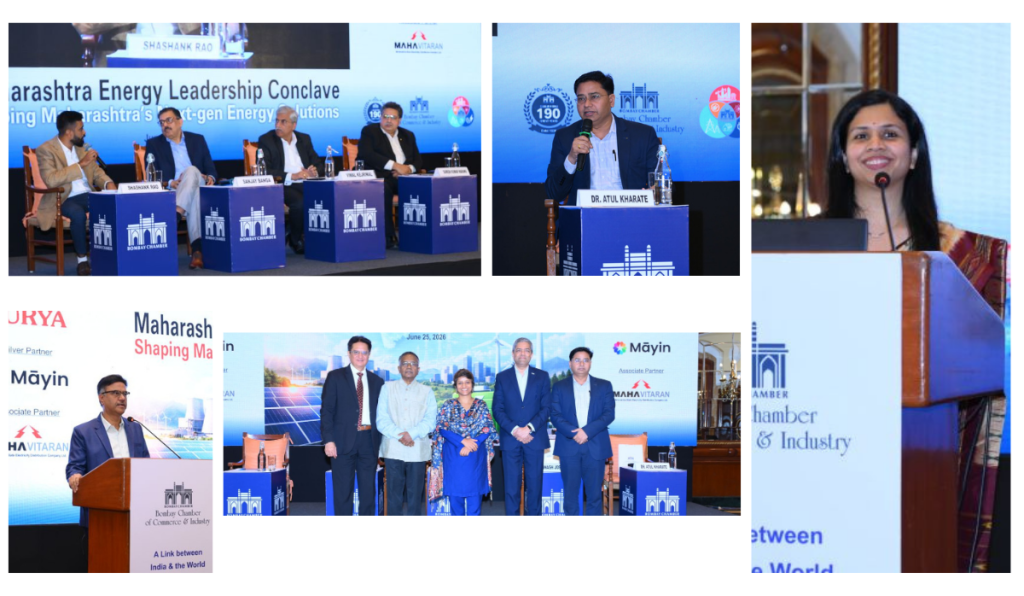
Mumbai: Maharashtra is on course to becoming a power-surplus state with plans to build up to 84 GW of power capacity to meet rising demand and support its ambitious economic growth, said Shri Vishwas Pathak, Independent Director, Maharashtra State Electricity Distribution Co. Ltd (MSEDCL), while delivering the Guest of Honour Address at the Bombay Chamber Maharashtra Energy Leadership Conclave 2026 on the theme “Shaping Maharashtra’s Next-Gen Energy Solutions.”
Addressing policymakers, industry leaders and energy experts, Shri Pathak said Maharashtra’s power sector has undergone a remarkable transformation over the past decade and is now positioned to power the state’s vision of becoming a $1 trillion economy. He credited the dynamic and visionary leadership of Hon’ble Chief Minister Shri Devendra Fadnavis for driving this transformation, supported by landmark infrastructure projects such as the Samruddhi Mahamarg, Atal Setu, Coastal Road, Missing Link and expanding Metro networks.
“Ten years ago, Maharashtra’s peak power demand was 16 GW and load-shedding was a weekly reality. Today, our energy requirement has doubled to 32 GW and is projected to reach 45 GW in the coming years. Mumbai cannot be a city without power, and even momentary outages are no longer acceptable,” Shri Pathak said, adding that Maharashtra today competes with many countries in power sector performance while maintaining stringent environmental standards.
Highlighting the state’s accelerating clean energy transition, he said thermal power, which contributed nearly 90% of the state’s electricity a decade ago, now accounts for around 50%, with renewable energy rapidly bridging the gap. Over the past two years, Maharashtra has tied up nearly 30 GW of additional capacity, including 26 GW of solar power, 6.6 GW of thermal power, and 6 GW of Battery Energy Storage Systems (BESS). Renewable energy investments under various MoUs are also expected to create nearly 12,000 jobs, while the state is exploring nuclear energy as a reliable clean-energy option for future baseload requirements.
Outlining Maharashtra’s long-term roadmap, Shri Pathak said, “To meet future demand and become power-surplus, Maharashtra will need to execute Power Purchase Agreements for up to 84 GW. We are strengthening the sector so that Maharashtra can not only meet its own energy requirements but also export power to other states.”
With nearly 30% of Maharashtra’s electricity consumption coming from agriculture, Shri Pathak said the government is rapidly expanding solar adoption among farmers. More than 50,000 farmers are already benefiting from distributed solar projects. Replacing conventional grid power costing around ₹9 per unit with solar power at approximately ₹3 per unit is expected to generate savings of nearly ₹80,000 crore over the coming years, even after government subsidies. “With sustained efforts by the Ministry and the State Government, electricity tariffs will come down as renewable energy penetration increases,” he added.
Welcoming the delegates, Sandeep Khosla, Director General, Bombay Chamber of Commerce & Industry, said, “As Maharashtra strengthens its position as India’s leading industrial and economic hub, access to reliable, affordable and sustainable energy will be critical to supporting its future growth. Through this Conclave, we aim to identify pathways for building a resilient, future-ready energy ecosystem for Maharashtra by bringing together leaders from government, industry and the energy sector to discuss technology, investment, infrastructure, policy and collaboration.”
The Conclave brought together senior government officials, regulators, utilities, industry leaders, technology providers and energy experts to deliberate on strategies for accelerating Maharashtra’s clean energy transition and strengthening its leadership in India’s evolving energy landscape.
Setting the theme for the Conclave, Venkatesh R, Vertical Head for Power Group, Bombay Chamber and Managing Director & Director – Energy Business, Wärtsilä India said, “Reliable electricity, robust transmission networks and advanced storage technologies will become critical enablers of India’s digital economy.” He added that energy transition cannot be achieved in isolation. “Policymakers, regulators, utilities, technology providers, investors and consumers must work together to build an integrated and resilient energy ecosystem,” he said.
A Leadership Dialogue on How Maharashtra’s Largest Energy Consumers Are Shaping the Future of Power Demand was moderated by Dr. Kiran Kabtta Somvanshi, Journalist, Writer and Visiting Professor, ex-Economic Times and the panelists included Avinash Joshi, Executive Managing Director, India, NTT Data; Dr. Atul Kharate, Chief Operating Officer, IndianOil Adani Ventures and K. R. Venkatadri, Former CCO, Tata Chemicals.
The second Leadership Dialogue: Who Will Power Maharashtra 2035? Technology, Capital and Capacity for the Next Energy Leap was moderated by Shashank Rao, Senior Assistant Editor, Hindustan Times and the panelists were Sanjay Banga, Chief Exe cutive Officer and Managing Director and President, Tata Power Renewable Energy; Vimal Kejriwal, MD & CEO, KEC International and Suresh Kumar Narang, Former CEO, Nabha Power, a wholly owned subsidiary of Larsen & Toubro and EVP & Head – LTECLS, L&T Energy CarbonLite Solutions – Larsen & Toubro.
In a virtual address on the theme Building Future-ready Energy Ecosystems: Maharashtra–Egypt Collaboration for Sustainable Growth, special guest, Dr. Ahmed Mohina, first Undersecretary for Strategic Planning and Electrical, Ministry of Electricity and Renewable Energy, Arab Republic of Egypt shared that to encourage private sector participation in power, Egypt has allocated more than 42,000 square kilometres of land for renewable energy and green hydrogen projects. Comprehensive solar and wind resource data are freely available to investors, while long-term 25-year Power Purchase Agreements (PPAs) backed by government guarantees provide financial certainty.
The concluding remarks were presented by Amit Kekare, Committee Chairman- Power and Infrastructure, Bombay Chamber and Vice President – Head of eMobility, Siemens Ltd. India.