

 Login
Login
Excluded EPF members drawing wages upto Rs 25,000/- brought into pension coverage.
Notification attached.
Excluded EPF members drawing wages upto Rs 25,000/- brought into pension coverage.
Notification attached.
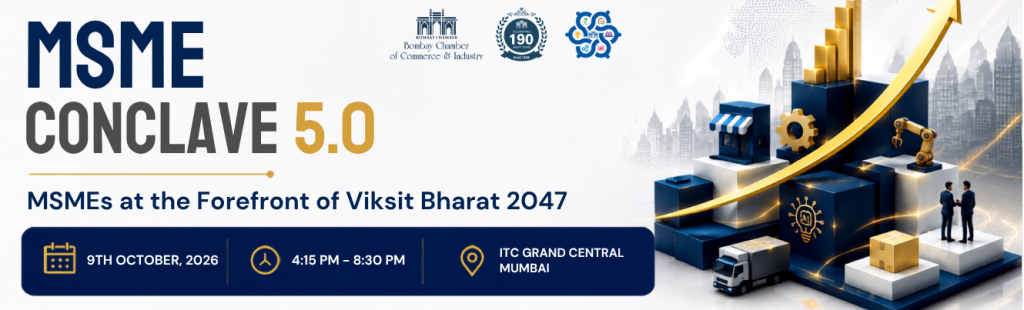
India’s vision of becoming a developed nation by 2047 places Micro, Small and Medium Enterprises (MSMEs) at the centre of the country’s economic transformation. MSMEs contribute to employment, exports and regional development, but scaling up and competing globally will require stronger value chains, wider technology adoption, better access to capital and greater participation in international markets.
The Bombay Chamber of Commerce & Industry will host MSME Conclave 5.0 on Friday, 9 October 2026, at ITC Grand Central, Mumbai. The conclave will bring together entrepreneurs, policymakers, industry leaders, financial institutions, technology providers and investors to discuss practical ways to strengthen MSMEs.
The opening session, Future-Ready MSMEs: Strengthening Strategic Value Chains for Viksit Bharat 2047, will examine the role of MSMEs across sectors including defence, automobile, chemicals and food processing.
The session will explore how MSMEs can strengthen strategic value chains, improve their competitiveness and contribute more effectively to the broader industrial ecosystem.
Technology and digital transformation will be another key focus of MSME Conclave 5.0. AI-Powered MSMEs: Building the Enterprises of Tomorrow will explore various applications of Artificial Intelligence for manufacturing and supply chains, supported by case studies and practical insights on developing an AI roadmap for organisations.
The session will provide an opportunity to understand how MSMEs can approach AI adoption and digital transformation while exploring the possibilities of building more future-ready enterprises.
As MSMEs look towards expanding their participation in global value chains and export markets, the conclave will also focus on international trade, innovation and global competitiveness.
Dedicated presentations will look at how the India–UK CETA can support MSMEs, opportunities through the India–New Zealand FTA, and strategies for building export-ready and globally competitive MSMEs.
These discussions will focus on opportunities for MSMEs to strengthen their global outlook and identify pathways towards greater participation in international markets.
Access to finance, credit and investment opportunities remains an important part of enabling MSME growth.
Financing Growth: Unlocking Capital for MSME Expansion will bring together perspectives from fintechs, NBFCs and banking institutions, creating a platform to discuss financing opportunities relevant to MSME expansion.
The programme will also include a presentation on investment opportunities, along with a presentation by New India Assurance, followed by the formal closing of the conclave and networking opportunities.
The conclave is designed for MSME owners and entrepreneurs, startups and emerging enterprises, manufacturing and service-sector MSMEs, policymakers, government officials, financial institutions, export promotion bodies, technology providers, investors, venture capitalists, private equity firms, and corporate procurement and supply chain leaders.
Participants can expect discussions centred on:
Whether you lead an MSME, finance one, supply technology to one or work with MSMEs through procurement and policy, the conclave offers a chance to exchange ideas and make connections across the wider ecosystem.
Join MSME Conclave 5.0 on October 9, 2026, at ITC Grand Central, Mumbai, and be part of the conversation on strengthening MSMEs for Viksit Bharat 2047.
Friday, 9 October 2026
ITC Grand Central, Mumbai
Be part of the conversation on strengthening MSMEs for Viksit Bharat 2047.
Insurance Partner: New India Assurance
Knowledge Partner: Kirtane & Pandit Consulting
Co-Sponsor: CRIF

How will banks use AI to serve customers better while earning their trust? And what will it take to make an increasingly digital financial system more resilient?
Bombay Chamber of Commerce & Industry’s Banking Conclave 4.0 will bring together voices from banking, financial services and technology to examine these questions and the choices shaping the sector’s next decade.
The banking and financial services landscape continues to evolve as artificial intelligence, digital technologies and changing customer expectations introduce new opportunities and challenges. From enhancing customer experiences to strengthening financial infrastructure, these developments are opening up important conversations about the future of banking.
The Conclave will provide a platform for discussions on the opportunities, challenges and considerations surrounding the evolving banking ecosystem.
AI is changing how financial institutions engage with customers and one another, personalise services, streamline operations and manage risk.
The panel discussion on AI-Powered Banking: Transforming Customer Experience will explore perspectives on how AI and digital innovation relate to the changing expectations of banking customers.
As financial services become more connected, the strength of the wider ecosystem matters as much as the services offered by individual institutions. This discussion will explore the role of AI and digital infrastructure in building resilience, and the challenges that greater interconnection brings.
For professionals working across banking, financial services, financial technology and related sectors, the Conclave offers an opportunity to engage with discussions relevant to the industry's evolving landscape.
The programme brings together perspectives from banking executives, policymakers and technology leaders, with conversations covering AI-powered customer experience, digital transformation and the development of a resilient financial ecosystem.
Whether your professional interests lie in banking strategy, digital innovation, financial infrastructure or the future of customer engagement, Banking Conclave 4.0 offers an opportunity to explore these subjects in a focused industry setting.
Registrations open
9 October 2026 | 9:30 AM – 1:30 PM
ITC Grand Central, Mumbai
With the Conclave approaching, now is the time to secure your participation. Join the conversations exploring the next decade of banking.
For more details Contact:
Utkarsha Joshi
utkarsha.joshi@bombaychamber.com
022-61200271
Priya Singh
priya.singh@bombaychamber.com
022-61200238
Co- Sponsor: CRIF
Supporting Partner: rSutra Analytics and Consulting Pvt. Ltd.
Knowledge Partner: Kirtane & Pandit Consulting
#BankingConclave 4.0 #AIInBanking #FutureOfBanking #DigitalTransformation #FinancialServices
In a defining step forward for trade and economic partnership, the India–New Zealand Free Trade Agreement, is going to enter into force on 20th October 2026. The FTA was signed on 27th April 2026 at Bharat Mandapam, New Delhi, by Union Minister of Commerce and Industry Shri Piyush Goyal and New Zealand’s Minister for Trade and Investment Hon. Todd McClay.
Today, the Union Minister of Commerce and Industry Shri Piyush Goyal and New Zealand’s Minister for Trade and Investment Hon. Todd McClay spoke via virtual conference and announced the date for entering into force of the agreement following the completion of internal processes in both countries. The legislation was passed by the New Zealand Parliament on 16th September, 2026.
Under the visionary leadership of Hon’ble Prime Minister Shri Narendra Modi, India and New Zealand have continued to deepen and expand their engagement. The visit of Hon’ble Prime Minister Shri Narendra Modi Ji to New Zealand in July 2026, the first visit by an Indian Prime Minister to New Zealand in four decades, provided further momentum to the bilateral relationship and emphasised the importance of the early implementation of the India-New Zealand FTA. The visit also marked an important elevation in the relationship, with India and New Zealand announcing a Strategic Partnership and endorsing the India-New Zealand Strategic Partnership: Roadmap to 2030 as a shared framework to guide cooperation over the next four years including an aspirational goal of doubling bilateral two-way trade in goods and services to NZ$7 billion (approximately ₹35,000 crore) by 2030. Operationalisation of the FTA will serve as a key enabler for translating the ambitions of the Strategic Partnership: Roadmap to 2030 into tangible economic outcomes.
Highlighting the significance of the milestone, the Hon’ble Commerce & Industry Minister Shri Piyush Goyal said “ The India-New Zealand FTA would provide fresh momentum to the bilateral partnership, create greater synergies between the two economies, enable economies of scale and contribute to enhancing overall competitiveness”. Emphasising the symbolism of the chosen date, he said, “We have chosen the auspicious day Dussshera- Vijay Dashmi for the entry into force of the India-New Zealand FTA. I am confident that the entry into force will overcome all hurdles that stood between our trade, technology and investment relationship, and will ensure prosperity for people of both sides”.
Hon. Todd McClay, Minister for Trade and Investment, noted that at a time of uncertainty in trade and rising tariffs, India New Zealand FTA gives confidence. With hard work, we have delivered one of the highest quality agreements concluded in nine months, which will provide tangible benefits to businesses and stakeholders on both sides. He highlighted that the Agreement is a great foundation for both Governments to cooperate in greater areas, be it people-to-people cooperation, culture, sports, business or investment and we will work together to address challenges faced by businesses to create greater employment opportunities on both sides.
From the entry into force, every single tariff line covering 100% of India’s exports to New Zealand becomes duty-free, offering Indian industry a level playing field that puts it on par with New Zealand’s other trading partners. Sectors that power livelihoods across the country – textiles and apparel, leather and footwear, gems and jewellery, engineering goods and processed foods – stand to gain immediately as New Zealand’s peak tariffs of up to 10% are eliminated. Indian manufacturers will also benefit from tariff-free access to critical inputs such as wooden logs, coking coal and metal scrap, sharpening their competitive edge in global markets.
At the same time, the Government has safeguarded the interests of Indian farmers by keeping sensitive products such as dairy, animal meat (except sheep), key agricultural commodities, sugar and edible oils excluded from tariff concessions. A calibrated market access has been structured for New Zealand’s apples, kiwifruit and Manuka honey through Tariff Rate Quotas with Minimum Import Price and seasonal import windows, alongside safeguards to protect domestic farmers. The Agreement establishes an Agriculture Productivity Partnership to strengthen cooperation in agriculture, with dedicated Action Plans for kiwifruit, apples and honey aimed at improving productivity, quality and farmer incomes in India. Centres of Excellence will be established for orchard management, post-harvest practices, supply chains, food safety and sustainable beekeeping, facilitating the exchange of knowledge, technology and capacity. A Joint Agriculture Productivity Council will monitor that the market access is complemented by cooperation activities by New Zealand under Agriculture Productivity Partnership.
The FTA also sets the stage for deeper investment gains for India, with New Zealand’s commitment to facilitate USD 20 billion in investment into India. This investment by New Zealand will benefit Indian agriculture, manufacturing, infrastructure and start-ups.
For India’s rapidly growing services sector, the Agreement creates a stronger platform for Indian companies and professionals to access the New Zealand market and expand their international footprint spanning roughly 118 sectors including IT, professional services, audio-visual, construction and tourism, with Most-Favoured Nation treatment locked in across about 139 sub-sectors, mobility opportunity through a dedicated quota of 5,000 Temporary Employment Entry visas for skilled Indians and 1,000 Working Holiday visas each year for young Indians. The agreement also provides uncapped student mobility with post-study work rights of up to three years for STEM graduates and four years for doctoral scholars.
India’s pharmaceutical and medical device exporters gain a long-awaited edge as New Zealand begins accepting inspection approvals from globally trusted regulators such as the US FDA, EMA, UK MHRA and Health Canada, cutting long waiting time and speeding up market entry.
With bilateral merchandise trade already at around USD 1.1 billion in 2025-26, the entry into force of the India-New Zealand FTA is set to give a decisive push to two-way trade, investment and job creation in the years ahead. Anchored in the vision of Viksit Bharat @2047, the Agreement stands as another testament to India’s growing network of partnerships with developed economies – one that places farmers, women, youth, artisans and MSMEs at the very heart of its gains.
Link for India-New Zealand Factsheet https://www.commerce.gov.in/files/2026-04/final_0.pdf
Link for FAQs https://www.commerce.gov.in/files/2026-04/FAQs%20-%20India-New%20Zealand%20FTA.pdf
Link for India New Zealand FTA Signing – https://www.pib.gov.in/PressReleasePage.aspx?PRID=2255914®=3&lang=1
no cognizance could therefore have been taken on a complaint filed by the vice-president on behalf of company without a resolution to that effect – Bombay HC
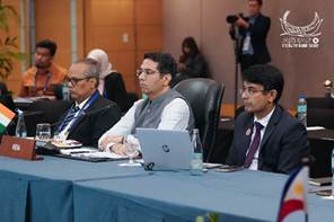
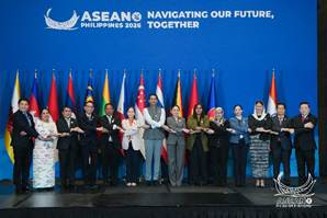
The Indian delegation led by Additional Secretary, Department of Commerce, Shri Nitin Kumar Yadav, participated in the 14th East Asia Summit Economic Ministers’ Meeting (EAS-EMM) and the 23rd ASEAN-India Economic Ministers Consultation held in Manila, Philippines.
Economic Ministers or their representatives from all 11 ASEAN countries — Brunei, Cambodia, Indonesia, Laos, Malaysia, Myanmar, Philippines, Singapore, Thailand, Timor-Leste and Vietnam — participated in the meetings along with EAS partners, including India, Australia, China, Japan, New Zealand, Korea, Russia and the United States.
The meetings facilitated an exchange of perspectives on prevailing regional and global economic developments. The ASEAN Secretariat provided a briefing on the regional and global economic outlook for 2027, including the anticipated implications for trade and investment flows.
The Economic Research Institute for ASEAN and East Asia (ERIA) also presented its paper, “Powering the EAS Region’s Next Wave of Growth: An Integrated Approach to Energy Security and Industrial Clusters.” The paper outlined an integrated approach to energy security and industrial clusters, bringing together energy infrastructure, digital and industrial demand, and coherent trade and investment policies.
During the ASEAN-India Economic Ministers Consultation, India highlighted its continued commitment to fostering strong trade partnerships and ensuring that regional trade agreements are mutually beneficial. The discussions placed particular focus on the ongoing review of the ASEAN-India Trade in Goods Agreement (AITIGA), which is aimed at facilitating enhanced trade flows and addressing existing trade asymmetries.
In 2025–26, bilateral trade between India and ASEAN reached USD 128.38 billion, with ASEAN accounting for 10.55 per cent of India’s total global trade, underscoring the importance of the partnership.
India reiterated its commitment to ensuring that the outcome of the AITIGA review is mutually beneficial and makes the agreement balanced, more effective, user-friendly and trade facilitative for businesses.
On the sidelines of the meetings, the Indian delegation interacted with Indian businesses operating in the Philippines on 22 September 2026 and discussed the issues faced by them while exporting commodities and services. The delegation also participated in the ASEAN-India Business Forum 2026, organised on 23 September 2026.
Ref.: MCM/ADM/11
The Director General
Bombay Chamber of Commerce and Industry
Mackinnon Mackenzie Building
3rd floor, 4, Shoorji Vallabhdas Road
Ballard Estate, Mumbai – 400 001
Dear Sir/Madam,
Invitation for Bids
Please see enclosed notices for invitation for bids from organizations in Mauritius.
Prospective bidders may be requested to regularly visit the website to take cognizance of any addendum and/or clarification(s) issued.
The Consulate would highly appreciate if you could kindly circulate the Notices among the members of your Organization.
Thank you for your understanding and cooperation.
Yours sincerely,
Principal Employer not liable to pay gratuity to Contract Labour – Supreme Court
Central Government notifies increase in EPF wage ceiling to Rs 25,000/- per month