
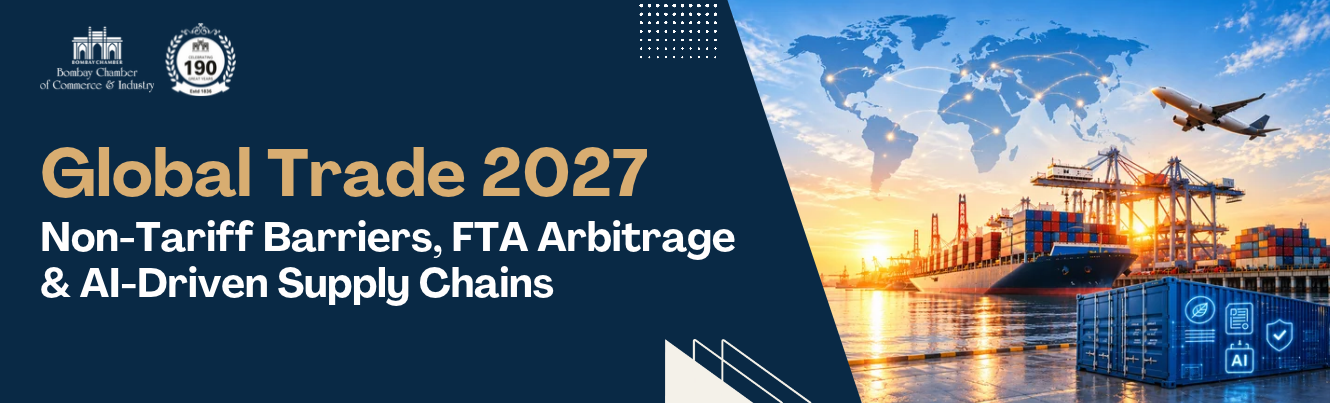
(Online) Global Trade 2027: Non-Tariff Barriers, FTA Arbitrage & AI-Driven Supply Chains

Bombay Chamber of Commerce and Industry

(Online) Global Trade 2027: Non-Tariff Barriers, FTA Arbitrage & AI-Driven Supply Chains

by Bombay Chamber of Commerce and Industry
17 17 people viewed this event.

Traditional trade barriers (tariffs and quotas) are rapidly being replaced by sustainability-linked trade barriers, digital origin scrutiny, and aggressive supply-chain compliance. From the financial implementation of the EU Carbon Border Adjustment Mechanism (CBAM) to rigorous origin audits under CAROTAR 2020 and shifting geopolitical corridors, Indian businesses face severe margin risks if they rely on obsolete operating procedures.

This masterclass equips corporate leaders and MSMEs with operational tools to audit carbon border liabilities, monetize preferential rules of origin across new FTAs, restructure currency risk away from volatile corridors, and deploy autonomous AI agents to eliminate documentation bottlenecks.

Contents:

Day 1: Trade Defenses, Non-Tariff Barriers & Strategic Sourcing

Focus: Protecting margins against carbon taxes, non-tariff border holds and navigating bilateral trade agreements.

Session 1: Deconstructing the EU CBAM, EUDR & Green Protectionism (90 Mins)

  • The New Non-Tariff Architecture: Scope of the EU Carbon Border Adjustment Mechanism (CBAM) covering steel, aluminium, cement, and chemical derivatives; EU Deforestation Regulation (EUDR) compliance for agri/textiles.
  • Calculating Embedded Emissions: Actual vs. default emission factor reporting; structuring tier-1 and tier-2 vendor data for EU buyer carbon declarations.
  • Contractual Risk Allocation: Drafting “Green Surcharge” and carbon reporting clauses in international sales contracts; avoiding penalties under EU TRACES and ETS frameworks.

· Case Study (30 Mins): CBAM Audit & EU Import Border Hold.

An engineering MSME exporting forged steel fittings to Germany faces a 22% punitive carbon certificate deduction and cancellation of contracts due to unverified Scope 1 & 2 supplier data. Deconstructing the step-by-step remediation via accredited third-party verification and contractual restructuring.

(11:30 AM – 11:45 AM: Tea Break)

Session 2: Advanced FTA Arbitrage & Origin Defense under CAROTAR 2020 (90 Mins)

  • Navigating India’s New Trade Pacts: Operational rulebooks of India-UAE CEPA, India-Australia ECTA, and European Free Trade Association (EFTA).
  • Origin Criteria Engineering: Calculating Regional Value Content (RVC), Value-Added Criteria, and Change in Tariff Sub-Heading (CTSH) across complex bill-of-materials.
  • Defeating CAROTAR 2020 Rejections: Standard operating procedures for building the mandatory Form I defense file; handling retrospective CoO inquiries, third-party invoicing traps, and ASEAN Single Window e-CoO issues.

Case Study (30 Mins): Disputed Origin & CAROTAR Duty Demand.

A consumer electronics manufacturer importing components from Vietnam/Thailand faces an Indian Customs investigation alleging third-country transshipment and lack of substantial transformation. How the importer leveraged supply-chain cost audits and bilateral administrative assistance to dismiss a ₹1.8 Crore provisional duty bond.

(1:15 PM – 2:15 PM: Lunch Break)

Session 3: Geopolitical Corridors, De-Dollarization & Sanctions Compliance (90 Mins)

  • Alternative Trade Corridors: Route optimization across the International North-South Transport Corridor (INSTC), Chabahar, and Gulf feeder pivots amid Red Sea disruptions.
  • Local Currency Settlements: Mechanics of Special Rupee Vostro Accounts (SRVA), INR-Dirham Local Currency Settlement (LCS), and handling non-convertible currency reserves.
  • Sanctions Due Diligence: Mitigating secondary sanctions risks (OFAC, EU sanctions) for dual-use goods, SCOMET licensing compliances, and end-user certificate verification.

Case Study (30 Mins): Receivable Traps & Sanctioned Transit Corridors.

An Indian agro-commodity exporter faces blocked banking channels and stalled cargo in a neutral transshipment port due to indirect ownership sanctions on the foreign vessel owner. How restructuring the payment through compliant multi-currency escrow facilities protected the firm’s cash flow.

Day 2: Autonomous Trade Operations, Dispute Law & Working Capital

Focus: Deploying AI in trade documentation, managing international legal disputes, and optimizing liquidity.

Session 4: Agentic AI & Next-Gen Trade Automation (90 Mins)

  • From Generative AI to Autonomous Agents: Using specialized AI models for autonomous discrepancy checking between Sales Orders, Commercial Invoices, Packing Lists, and Bills of Lading.
  • ICEGATE & ERP Digital Bridges: Automating shipping bill generation, HSN mapping, and automated RoDTEP/Duty Drawback reconciliation without manual CHA data entry.
  • AI-Powered Supplier & Buyer Due Diligence: Automating fraud checks, litigation tracking, and dynamic credit scoring on overseas counterparties before shipping on credit.

Case Study (30 Mins): Zero-Defect Documentation Overhaul.

How a mid-sized chemical distributor replaced a 6-person documentation desk with an automated document pipeline, eliminating human errors in shipping instructions, cutting bank discrepancy rejections to zero, and saving ₹18 Lakhs annually in processing fees.

(11:30 AM – 11:45 AM: Tea Break)

Session 5: International Contracts, Cross-Border Arbitration & Default Recovery (90 Mins)

  • Airtight Contract Drafting: Crafting enforceable clauses for Hardship, Price Escalation, Geopolitical Force Majeure, and Liquidated Damages.
  • Jurisdiction & Arbitration Strategy: Choosing between domestic courts vs. international arbitration hubs (SIAC, LCIA, ICC Paris); structuring two-tier dispute resolution clauses.
  • Asset Recovery & Maritime Arrests: Legal protocols for arresting cargo or securing maritime liens when foreign buyers commit intentional payment default after taking delivery.

Case Study (30 Mins): Cross-Border Arbitration & Out-of-Court Recovery.

A machinery exporter facing breach of contract by an East Asian distributor invokes expedited emergency arbitration under SIAC rules. Examination of how pre-arbitration injunctive relief forced the buyer into an immediate commercial settlement.

(1:15 PM – 2:15 PM: Lunch Break)

Session 6: Advanced Trade Finance & Off-Balance-Sheet Structuring (90 Mins)

  • Structured Working Capital: Structuring non-recourse export factoring, forfaiting, and supply chain finance (SCF) programs with global trade banks.
  • De-risking Open Account Trade: Combining trade credit insurance policies with dynamic forward laddering to offer 90-day open account terms without balance-sheet leverage.
  • UCP 600 & ISBP Masterclass: Advanced documentary defense: handling complex standby LCs, transferable credits, and back-to-back LC structures for merchant traders.

Case Study (30 Mins): Scaling Turnover Without Bank Debt.

How an export firm scaled from ₹30 Crores to ₹120 Crores in international revenue within 18 months by shifting from traditional Rupee bank borrowing to non-recourse receivable discounting backed by private credit insurers.

(3:45 PM – 4:00 PM: Valedictory, Open Q&A, and Action Plan Distribution)

Delivery:  ZOOM Meeting

Target Audience:

Exporters, Importers, CFOs, SCM Heads, Heads of International Business, In-House Legal Counsel, and Trade Compliance Officers.

Speaker Profile:

Dr. Vijesh Jain, Founder/Director, Ebizee Consulting and Training, Bangalore, is an international trade strategist, educator, and author dedicated to helping learners master the practical world of export–import operations, documentation, compliance, and global market strategy. With 37+ years of combined industry, academic, consulting, and research experience, he brings real- world clarity to one of the world’s most complex business domains.


He holds a B.E. from BITS Pilani, an M.I.B. from IIFT New Delhi, a Ph.D. in International Business, and is a Certified Global Business Professional (CGBP) from NASBITE, USA. Over the years, he has taught, trained, and mentored thousands of professionals across more than 200+ countries.


His mission is to help learners build confidence and succeed in today’s fast-evolving international business environment.

.

Participation Fee :

Members Rs. 10,000 + 18% GST
Non-Members Rs. 12,000 + 18% GST
Bank Details for NEFT
Account No. 10996680930
IFSC CODE SBIN0000300
Bank Name State Bank of India
Branch Address Mumbai Main Branch

Participation only through advance registration (Batch size 20 participants only)

Cheque /Demand Draft should be drawn in favor of “BOMBAY CHAMBER OF COMMERCE AND INDUSTRY”

Kindly mail your registration (Name, Cell no, Email Id and GST No) on revati.khare@bombaychamber.com

Contact Details :

Revati Khare || DEPUTY  DIRECTOR
Email : revati.khare@bombaychamber.com
Mobile No : 9892029473

Additional Details

Organizer name - Bombay Chamber of Commerce and Industry

Venue Name -

Event Fees Type

Event or Seminar - Training

To register for this event please visit the following URL: https://zfrmz.in/IfVU6zwcKTiLw1sk5cRl →


Date And Time

Thursday, November 19, 2026 10:00 AM to
Friday, November 20, 2026 05:00 PM
 

Registration End Date

Wednesday, November 18, 2026
 

Location

Online event
 

Event Types


Event Category

Share With Friends

MSME Toolkit
instagram default popup image round
Follow Me
502k 100k 3 month ago
Share